Why contract with us?
Smart energy management
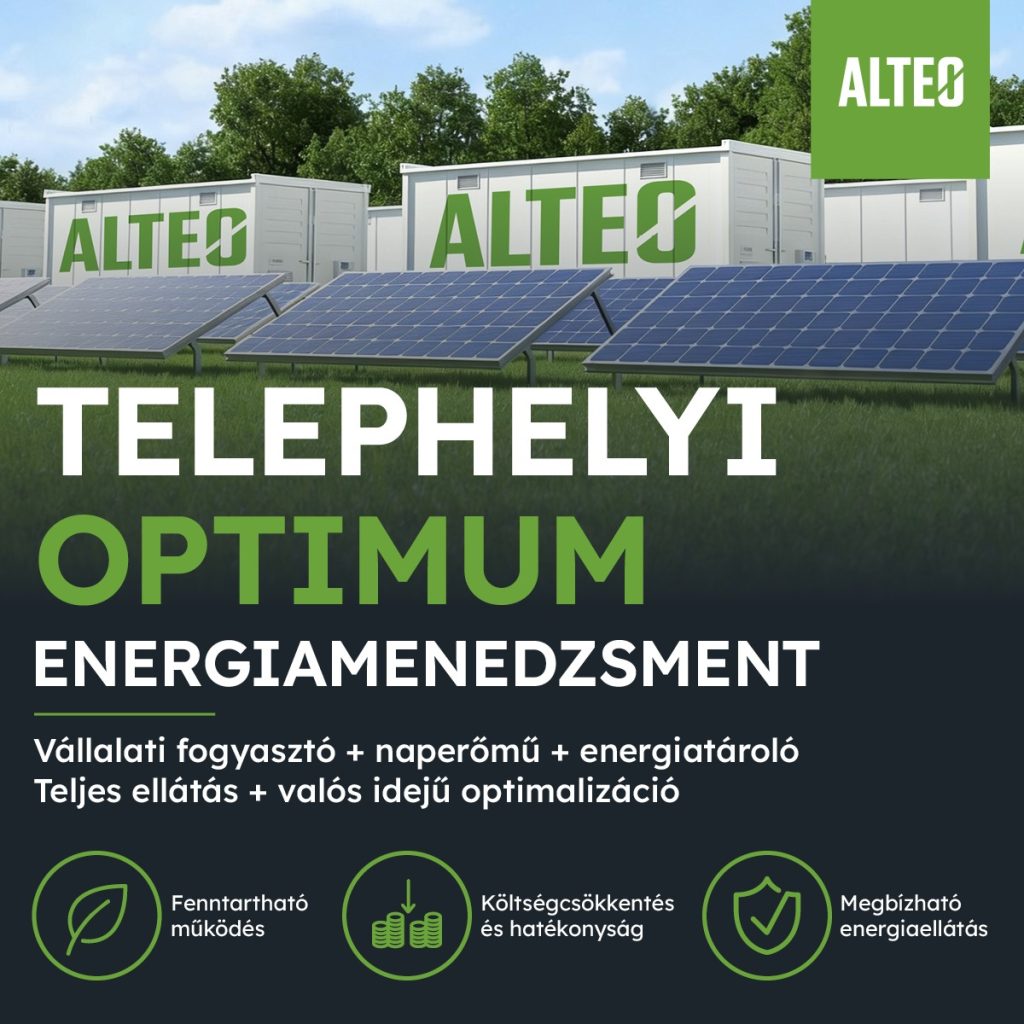
For our customers with a solar power plant and energy storage, we provide a comprehensive, full-supply-based service.
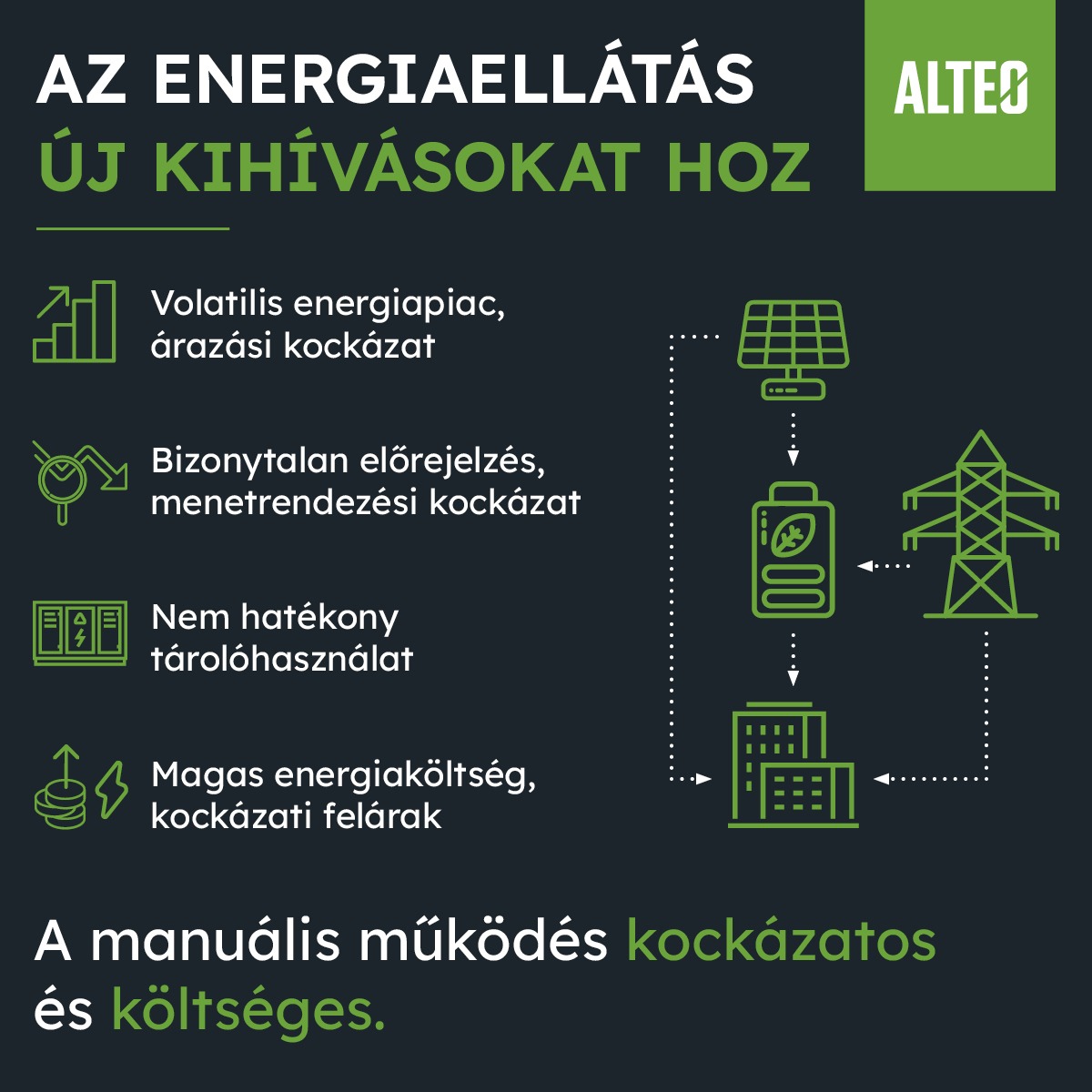
ALTEO’s on-site optimum-based solution supports more predictable, market-based optimised operation by coordinating generation, storage and off-take.
Electricity quote request — request one quickly through our partner portal
For a faster and more transparent quote request, use the customer portal we developed specifically for this purpose. Here our team of experts receives the data relating to your supply point and prepares a personalised offer.
Electricity quotation
If you would rather contact us here, fill in the form and we will call you back.
Natural gas quote request — through the partner portal, in a few steps
On the altenergy.hu customer portal you can submit the supply point data directly, so we can prepare a personalised offer more quickly.
Natural gas quotation
If you would rather contact us here, fill in the form and we will call you back.
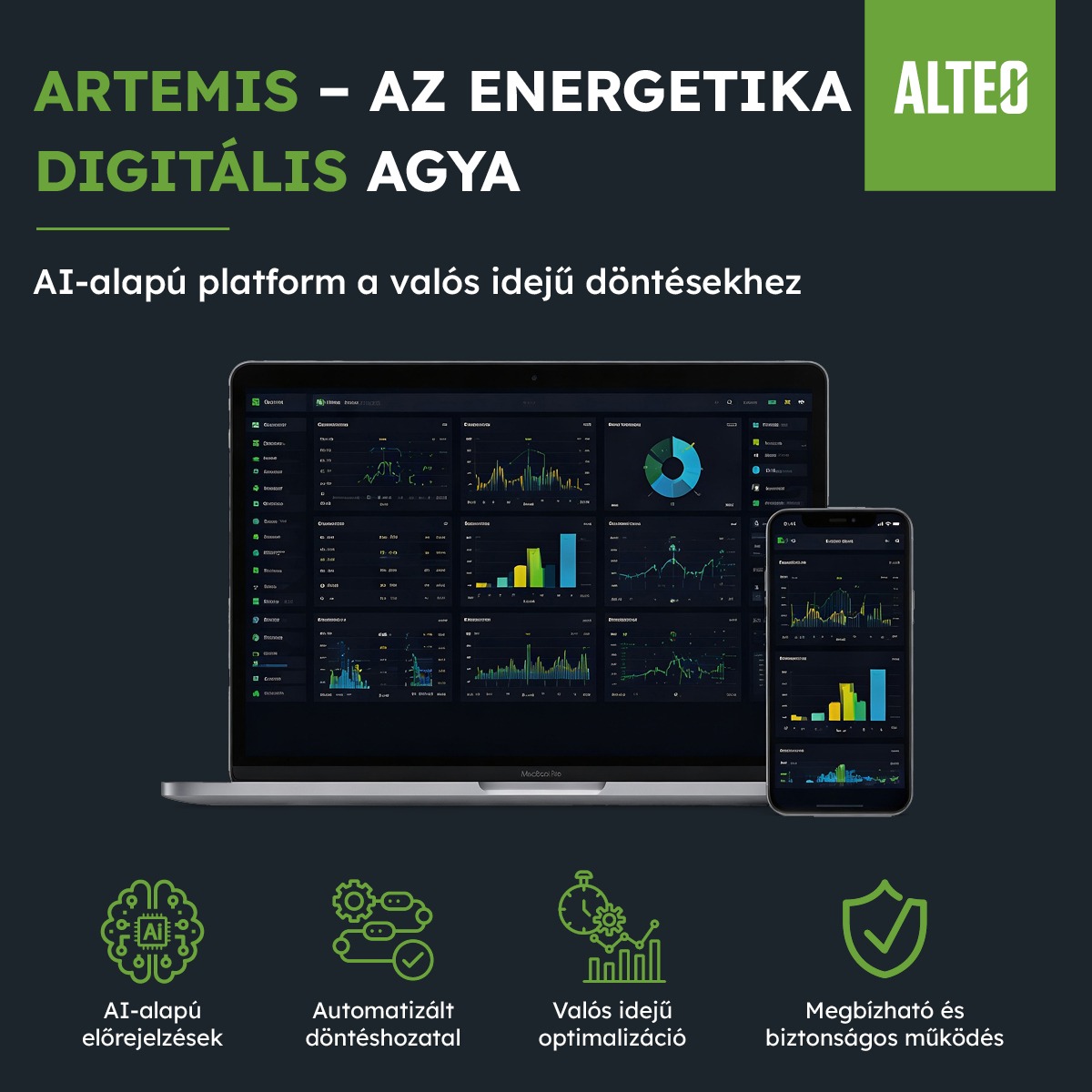
Experience, capacity and digital production management in a single hand
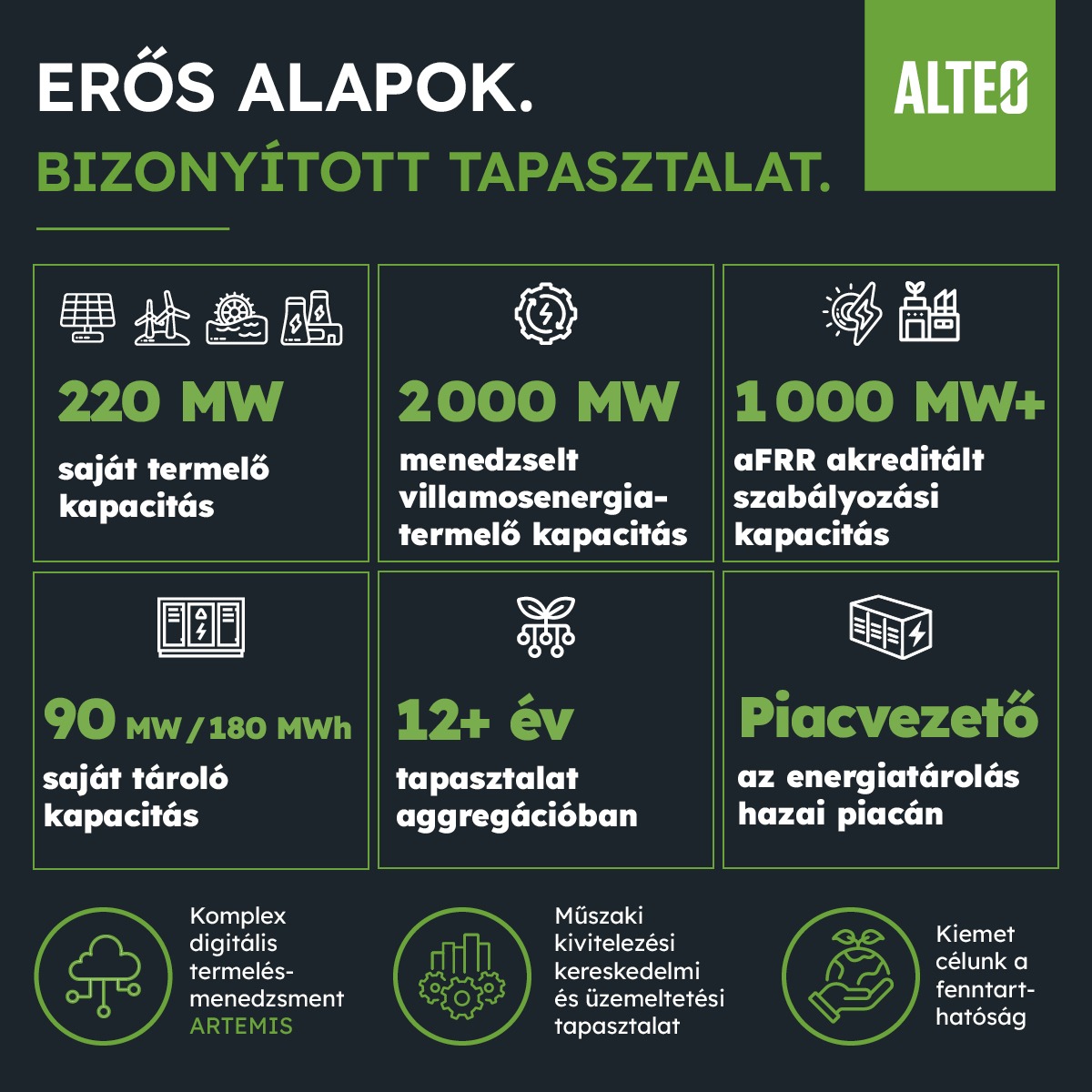
With more than a decade of aggregation experience and significant managed capacity, ALTEO supports the domestic development of energy storage and on-site energy management.
Full-scope supply and trading service for co-location sites
The aim of the service is to make the operation of sites equipped with a solar power plant and energy storage commercially optimised, flexible and transparent as well.
On-site optimum-based supply
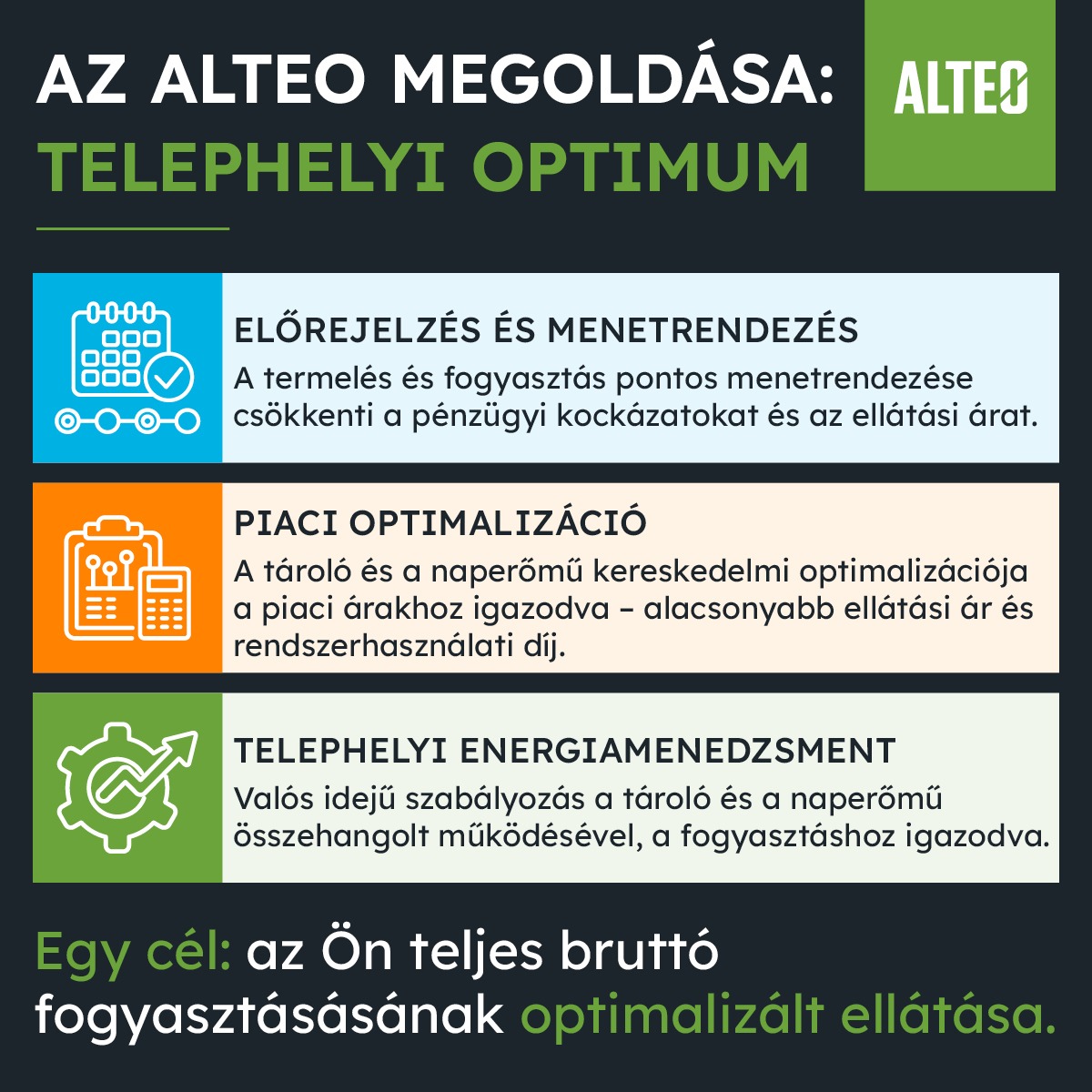
Forecasting and scheduling
Accurate scheduling of on-site generation and consumption reduces financial risks, which results in a lower supply price.
Market optimisation
Commercial optimisation of the storage and solar power plant schedule, aligned with market price levels, minimising the supply price and the system usage fee.
On-site energy management
Real-time control of the coordinated operation of the storage and solar power plant (without intervening in consumption) for the sake of on-site energy balance, maximising the utilisation of renewable energy.
Tailored solution
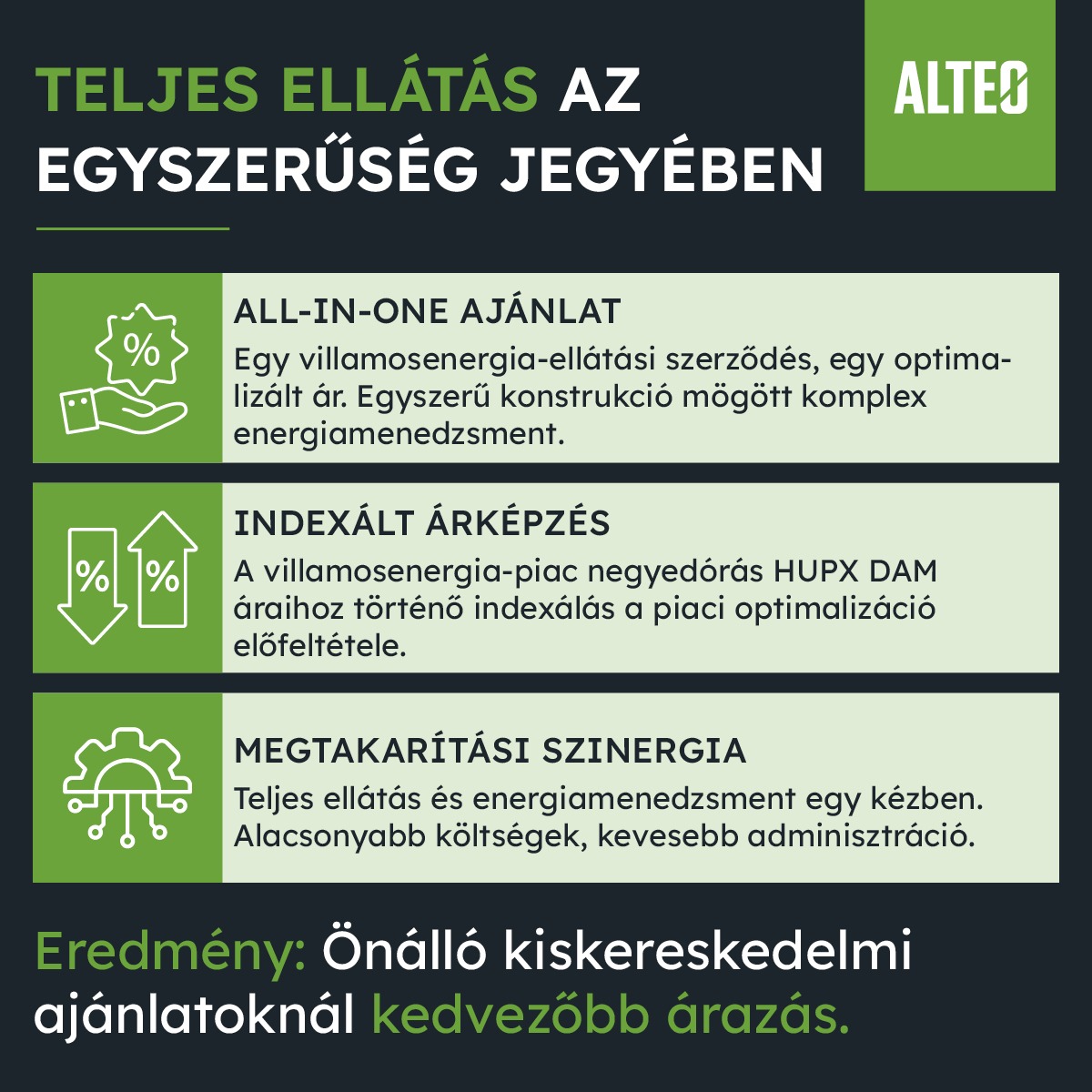
Indexed pricing
The energy charge is based on the site's net grid off-take, which — thanks to optimisation — is settled at a source cost lower than the market average price. Indexation to the quarter-hourly HUPX DAM price formed on the electricity market ensures transparent pricing and is also a precondition for market-price-based optimisation.
Flexible handling of on-site conditions
- Grid feed-in permit
- Free-market or KÁT solar power plant
- Storage without a solar power plant
- aFRR obligation
- Other generation technology
- Controllable consumer
A transparent path from first contact to energy management
The steps of the process help ensure that, after assessing the on-site conditions, a bespoke offer tailored to the operation is prepared.
-
1
Get in touch
You contact us by phone, e-mail or through the quote request form.
-
2
Completing the On-site Optimum data request form
You provide the most important energy data of your site so that we can accurately assess its conditions.
-
3
Compiling and sending a bespoke offer
Based on the on-site conditions, we compile and send a tailored, optimum-based supply offer.
-
4
Contract signing
Based on the accepted offer, we conclude the supply contract.
-
5
Control-system integration
We coordinate the control-system connection between the solar power plant, the storage and the metering system.
-
6
On-site Optimum energy management
Continuous, real-time scheduling and market optimisation begins — the site's energy management.

Request a tailored offer
Get in touch with us and we will put together an optimum-based supply solution tailored to your site.
Downloadable materials — Electricity
The current electricity trading Business Code and the relevant MEKH decisions. The full archive (previous versions, drafts submitted for consultation) is available on altenergy.hu.
Downloadable materials — Natural gas
The current natural gas trading Business Code and the relevant MEKH decisions. The full archive (previous versions from 2012) is available on altenergy.hu.
FAQ — Electricity
Who can buy electricity on the competitive market?
Consumers with a nominal connection capacity of 3×63 Amperes are required to purchase from the competitive market, while consumers with a nominal connection capacity below this may decide freely.
What are the benefits of competitive supply?
Consumers purchasing from the competitive market may choose freely among the traders’ offers available on the market, on the basis of which they can conclude contracts for a defined period under set and fixed conditions. During the contract term, the contract conditions and the price do not change.
What is the universal service?
Electricity supply provided by a universal service provider holding a universal service licence, in accordance with state-controlled conditions and pricing rules. The universal service may be used by those entitled to it, who may also freely decide in favour of the competitive-market form of purchase.
How can a meter capable of recording the load curve be obtained?
Installing the consumption meter, based on the consumer’s request, is the obligation of the Network Licensee.
How does entering the competitive market work?
A basic condition for entering the competitive market is that the market participant holds an electricity trading contract and a balancing-group membership contract (the latter is often included in the trading contract). To conclude the contract, requesting several traders’ offers is recommended, based on the annual consumption volume. After the contract is signed, the trader reports the market participant’s entry into the competitive market to the Network Licensee; the user must terminate its universal service contract at least 30 days before entering the market, in accordance with its terms.
How does switching trader work?
After the electricity trading contract is signed, the trader switch is reported to the Network Licensee by the new trader.
Whom should you notify in a power outage?
Power outages and other network problems can be reported through the fault-reporting channel of the territorially competent Network Licensee.
What is the role of the Grid Licensee?
The owner and operator of the network system used to deliver and distribute electricity to the end-user point, which is entitled to collect system usage charges for these activities. The licensee’s activity is bound to a specific territory and cannot be chosen by market participants.
For what term can a trading contract be signed on the competitive market?
Based on an individual agreement between the User and the Trader, contracts with individual terms may be concluded. In practice, most contracts run for one calendar year.
Which contracts must be signed between the Consumer and the Grid Licensee?
The Consumer must have a network connection contract and an available capacity and network usage contract in order to establish the conditions of system use.
After switching to the competitive market, how many invoices reach the user?
The electricity trader issues its invoice for the quantity of electricity it supplies to the consumer. The territorially competent Network Licensee is entitled to charge a system usage fee for providing the electricity network, on the basis of which it sends an invoice to the consumer.
What is the system usage fee?
For the operation, maintenance and supervision of the network system used to transmit the electricity delivered to the consumer, the territorially competent Network Licensee is entitled to charge the consumer a system usage fee, on the basis of which it sends an invoice to the consumer. System usage fees are set by the authorities and are identical everywhere in the country.
What does controlled consumption mean?
Electricity consumption of equipment operated intermittently in a period that is not predetermined but falls outside peak hours, where the equipment is connected to a controlled circuit.
How is invoicing done in profile-based settlement?
For profile-based consumption points, between the first and the penultimate month of the contract period, the trader charges a flat-rate fee based on the Reference Annual Consumption volume. In the last month of the contract period, a settlement invoice is issued.
What is the Reference Annual Consumption (RAC)?
The annual consumption volume determined for the consumer by the Network Licensee on the basis of previous consumption periods.
What is time-series settlement?
The electricity volume settlement system for users who have a metering device capable of recording a load curve.
How is invoicing done in time-series settlement?
The Trader issues a settlement invoice in every month of the contract period, based on their monthly consumption.
When are meter readings taken?
In the case of profile-based settlement, the meter is read by the Network Licensee once a year. In the case of time-series settlement, meter reading is practically continuous.
Can the Reference Annual Consumption be modified?
Yes, profile-based consumers may modify the Reference Annual Consumption volume by notifying the trader.
Where is the comparison tool operated by the Hungarian Energy and Public Utility Regulatory Authority (MEKH)?
https://eka.mekh.hu/home
FAQ — Natural gas
Where can I get information on energy-efficiency questions?
Users can find useful information about the energy efficiency measures available in their area on the energy efficiency website of the Hungarian Energy and Public Utility Regulatory Authority (https://www.enhat.mekh.hu/), and may also enquire at the Methodology Centre of the Energiaklub Policy Institute (1056 Budapest, Szerb u. 17-19., Tel.: +36 1-411-3520, energiaklub@energiaklub.hu, www.energiaklub.hu).
What deadline applies for switching from universal service to the competitive market?
A user of the universal service may terminate the universal service contract concluded for an indefinite period in writing, with 30 days’ notice.
What conditions must be met to switch from universal service?
If the user wishes to switch natural gas trader, the licensees carry out the process free of charge, and neither the natural gas trader nor the system operator may charge the user any fee in connection with it. To carry out the trader switch, the natural gas trader with whom the user concludes the new natural gas trading contract may also act on the basis of the user’s authorisation. The trader switch may take place if the conditions set out in the contract concluded with the previous supplier are met.
Can users freely choose between gas distributors?
Since in a given geographical area a single natural gas distributor operates under the licence defined by the act on natural gas supply, its services must be used for natural gas distribution, so there is no option to choose.
What contracts does the user need with the gas trader and the system operators?
The network connection contract and the distribution network usage contract previously concluded with the natural gas distributor remain in force; this contract governs the technical conditions of gas offtake and of connection to the network. The natural gas sale and purchase contract must be concluded with the natural gas trader; it contains the price of natural gas as a product, the fee for transmission, distribution and storage (system usage) to the point of use, as well as the other conditions of the sale.
Does the meter-reading schedule change when switching trader?
It does not change, since meter reading, independently of the natural gas trader, is the task and obligation of the natural gas distributor, who continues to perform its task unchanged on the basis of the relevant legislation, its Business Code and the contract concluded with the natural gas trader.
How is consumed gas volume converted from GJ to cubic metres?
The determination of the heat quantity delivered or received is in every case carried out on the basis of the rules laid down in the operational and commercial code of the Hungarian natural gas system (hereinafter: ÜKSZ), as well as the relevant provisions of the Business Codes of the transmission and distribution licensees. At every point of the cooperating natural gas system, settlements are made with reference to the standard gas-technical state, so the calorific value data required for settlement also relate to this state. Gas meters – without the installation of a corrector – are not suitable for the direct determination of the gas quantity referred to the standard gas-technical state, that is, gas meters do not measure this quantity characteristic but the so-called operating quantity. In order to determine the actually consumed heat quantity (GJ) from the operating quantity (m3) measured by the gas meter, the value measured by the gas meter must be multiplied by a so-called correction factor and by the calorific value. If calorific value data are not available, the Licensee uses the calorific value under the MER (the Quality Settlement Regime published by FGSZ Földgázszállító Zrt.) as a substitute value. The MER is available on the website of FGSZ Zrt.: https://fgsz.hu/ .
What is the difference in settlement between consumption points with gas meters below and above 100 m³/h rated capacity?
For consumption points with a nominal (total) capacity above 100 m3/h, the competent Distribution licensee is obliged to install remote metering, so the actual reading is entered into the system every day as remote data. This actual consumption will be the basis of settlement. For consumption points with a nominal (total) capacity below 100 m3/h – depending on the capacity of the meter, the distributor performs monthly/annual readings, which in most cases do not coincide with the settlement period. Thus, partial-period settlements may be made, under the conditions set out in the individual contracts, on the basis of monthly self-readings, contracted quantity, or distributor allocation. (* in the case of standard pressure below 100 mBar; in the case of operating pressure above 100 mbar, the natural gas distributor is entitled to convert the nominal capacity of the metering device to the standard gas-technical state.)
Where can you handle matters relating to the gas meter installed at your premises? (e.g. installation/removal due to conversion or upgrade, technical-fault reporting, capacity change, change of user data, etc.)
Matters relating to the gas meter (e.g. installation and removal of the meter due to conversion or upgrading, reporting of a technical fault, change of capacity, change of user data, etc.) fall to the territorially competent natural gas distributor; however, the natural gas distributor receives your request through the natural gas trader. You can submit your request to our company at the e-mail address energia@alteo.hu, or by post in a letter sent to ALTEO Energiakereskedő Zrt. at 1033 Budapest, Kórház utca 6-12., stating the name of your consumption point and its metering point identifier (POD: „39N…”). In the event of technical faults, we order a meter inspection from the natural gas distributor, which is usually carried out through an on-site examination by the natural gas distributor.
Is there a self-meter-reading option? What is billed without a reading?
For consumption points with a nominal (total) capacity below 100 m3/h, we provide the option of self-reading, which our users may submit until the 3rd working day following each subject month to the e-mail address menetrend@alteo.hu, stating their metering point identifier and the reading taken from the gas meter. If no self-reading is received in the given month by the deadline stated above, we prepare your invoice on the basis of estimated consumption.
How can you change the postal address for invoice delivery?
Our users can request the setting of a new invoice mailing address to our company by e-mail or by post, by contacting us at energia@alteo.hu, or at ALTEO Energiakereskedő Zrt., 1033 Budapest, Kórház utca 6-12.
You received an overdue-invoice notice but your records show it’s already paid. What to do?
If you have already settled your debt before the date of our notice, we recommend that you initiate a consultation with our colleagues by e-mail or by telephone in order to reconcile the discrepancy in the records.
Can they request instalment payment on an overdue invoice?
Our users may submit a request for payment relief only until the payment deadline of the documents. They can submit their request to our company in writing. They may request instalment payment once a year.
Glossary — Electricity
- Balance group
-
An organisation established for the balancing and settlement of the electricity produced and consumed.
- Balance group contract
-
A contract concluded between the balancing-group manager and the system operator that serves as the basis for balancing energy settlement and schedule notification.
- Balance group member
-
A member of the balancing group must conclude an agreement with the balancing-group manager regarding its membership in the balancing group.
- Balance group membership contract
-
A contract concluded between the balancing-group manager and a market participant.
- Balance-group balancing energy
-
The quantity of energy determined by the system operator between the confirmed schedule of the entire balancing group and the settled measurement results.
- Balancing energy
-
The regulating energy that offsets the schedule deviation of the balancing group, which may be positive or negative in direction.
- Balancing-energy settlement period
-
The period applied by the transmission system operator for which financial settlement is made with the balancing groups.
- Business Code
-
A code approved by MEKH that contains the licensee’s general terms and conditions.
- Connection point
-
The ownership boundary between the user’s equipment and the electricity works or line.
- Consumption
-
Offtake from the electricity network at a defined connection point.
- Distribution network
-
The network system used to deliver and distribute electricity to the end-user point.
- Full-supply contract
-
A supply-based contract that does not allow the buyer to conclude further schedule-based contracts.
- Grid connection agreement
-
A contract concluded with the territorially competent Network Licensee that serves to continuously ensure the conditions of the capacity available at the connection point.
- Grid usage contract
-
A contract concluded with the territorially competent Network Licensee that concerns the installation and operation of the consumption meter at the connection point, as well as the continuous provision of the offtake of the electricity purchased from the trader.
- Licensed producer
-
A market participant holding an electricity producer or small power plant licence.
- Low-voltage grid
-
A network with a nominal voltage not exceeding 1 kV.
- Market participant
-
Any of the following: an eligible consumer, producer, electricity trader, public utility wholesaler, public utility service provider, distribution network licensee, small power plant or system operator.
- Medium-voltage grid
-
A network with a nominal voltage greater than 1 kV and up to 35 kV.
- Monthly billing period
-
The period applied by the service provider for which the financial settlement is made.
- Organised electricity market
-
The trading system used to conduct standardised energy trading transactions.
- Point of consumption
-
The area of use of the electricity consumed by the user through the connection points.
- Profile type
-
A statistically determined consumer capacity type curve related to a given time interval and to an annual consumption of 1000 kWh.
- Profile-billed consumer
-
An eligible consumer purchasing from the low-voltage network with a nominal connection capacity of 3×80 Amperes or less.
- Residential consumer
-
A user who purchases electricity for the consumption of their own household and does not carry out economic activity for income-generating purposes with the energy so purchased.
- Schedule-based contract
-
An electricity sale and purchase contract that sets out the level of offtake broken down by settlement interval.
- Settlement measurement interval
-
The 15-minute settlement time unit for feed-in to and offtake from the network.
- Settlement point
-
The metering point used for the settlement of the schedule unambiguously assigned to the connection point, which serves to unambiguously identify the balancing-group member.
- Single-source supply
-
The consumer concludes a supply contract with one market participant for the procurement of electricity.
- Supply-based contract
-
A commercial contract in which, for a defined period and under fixed financial conditions, the seller undertakes to provide the quantity of electricity corresponding to the buyer’s supply needs.
- System usage fee
-
An authority-set and nationally uniform charge to which the territorially competent Network Licensee is entitled for operating the network.
- Transmission network
-
The network system used for the transmission of electricity.
- Unit price of balancing energy
-
The unit price of the balancing energy determined by the transmission system operator for the settlement interval, in HUF.
- User
-
The person who takes electricity through the network.
- Volume variance (for profile-billed consumers)
-
The difference between the reference annual consumption and the actually measured consumption volume.
Glossary — Natural gas
- What is a gas year?
-
The period from 6.00 a.m. on 1 October of the calendar year to 6.00 a.m. on 1 October of the following calendar year, according to the local time in force at the delivery-acceptance point.
- What is heating value?
-
The quantity of heat released during the complete combustion in air of a specified (1 m3) quantity of gas at constant pressure, if the final temperature of the combustion product is equal to the initial temperature, and both the initial components and the products of combustion are in the gaseous state. The calorific value is determined on the basis of the chemical composition of natural gas; its unit of measurement is MJ/m3.
- What is natural gas?
-
Natural gas is a natural combustible gas that formed in the earth’s crust, reaches the surface during mining activity, and can be used safely, in an environmentally and technical-safety compliant manner, in any equipment used in accordance with the act on natural gas supply, including gases of natural gas quality originating from biomass and other non-mining sources. Gases of natural gas quality originating from biomass and other non-mining sources are artificially produced gas mixtures that, under the conditions defined in the legislation on the implementation of the provisions of the act on natural gas supply, can be introduced into the cooperating natural gas system in an environmentally and technical-safety compliant manner, can be mixed with natural gas, and this mixture, when introduced into the natural gas system, meets the requirements for natural gas quality.
- Who are the main players on the piped gas market?
-
The users, system operators, system users and producers.
- Who are the system operators?
-
The transmission system operator, the natural gas storage licensee and the natural gas distributor.
- Who is the gas distributor?
-
The natural gas distributor carries out the transmission of natural gas to the user via the distribution pipeline. Natural gas distribution is a licensed activity under the act on natural gas supply.
- Whom do we call a gas trader?
-
The natural gas trader carries out the commercial purchase and sale of natural gas, for consideration and not for its own use, which is a licensed activity under the act on natural gas supply.
Energy certifiers and savings notices
Pursuant to Section 23/A(6) of Government Decree 273/2007 (X. 19.) and Section 23/A of Government Decree 19/2009 (I. 30.), please be informed that the list of energy certifiers is available in the following sources:
Hungarian Chamber of Engineers: http://mmk.hu/kereses/tagok — szakterület kódok: EN-korlátozott, Ent-Sz, TÉ.
Hungarian Chamber of Architects: https://eugyintezes.mekon.hu/index.php?u=nevjegyzek# — “TÉ – Energetikai tanúsítói jogosultság” kulcsszóval.
Hungarian Energy and Public Utility Regulatory Authority: http://energiahatekonysag.mekh.hu (általános), http://www.mekh.hu/energiahatekonysag-villamos-energia (villany), http://www.mekh.hu/energiahatekonysag-foldgaz (gáz).
Grant and funding sources: http://palyazatmenedzser.hu/cimke/energetikai-palyazatok/, http://www.palyazatihirek.eu/energiatakarekossag, http://palyazatok.org/lakossagi-energiahatekonysagi-palyazatok-kisokos/, http://www.emi.hu/emi/web.nsf/Pub/palyazatok.html.
Hungarian Association of Energy Consumers — 1091 Budapest, Üllői út 25. Email: mesz.iroda@freemail.hu, Website: www.energiafogyasztok.hu, Tel: +36 1 210-7116.